

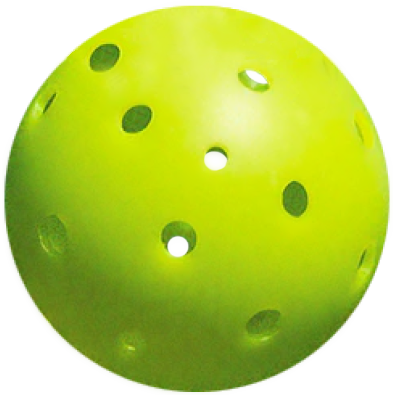
Paddle Lab
Your Trusted
Doubles Partner,
Backed by Science
Discover in-depth insights into performance with our data-driven scoring system, designed to help you find the ideal pickleball paddles.
OUR MISSION: Bringing Science to Your Game
We created Paddle Lab to help players use data to unlock their full potential on the court. When we get a new paddle in our inventory, we take it straight to the lab and conduct rigorous testing to gather its key performance measurements.
So whether you’re searching for more pop on your drives, extra spin on your serves, or more consistency to your game, our numbers can help you find your perfect paddle.
Paddle Lab in Under 3 Minutes
Video Transcript
[Music]
Welcome to Paddle Lab, the science proving ground here at Just Paddles. I'm Louis from Pickle Ball Pursuit, and today I'll be showing you around this place. Here, when a paddle comes through the Just Paddles doors, it gets put to the test. They're not testing for certification. They're testing to capture the performance data that helps players like you find the perfect paddle for your game. No bias, just data. Ready to see how it works?
When they get a new paddle in, it goes straight to the paddle lab. Each one gets tested the exact same way using the same type of pickle ball for every test to ensure consistency. This lab is equipped with cutting-edge technology to measure six key performance characteristics.
Exit velocity, swing weight, spin rate, twist weight, consistency, and balance point. Exit velocity is the speed at which the ball leaves your paddle after contact. Higher numbers means more power potential, while lower numbers indicate more control. Swing weight tells you how heavy a paddle feels during play. Heavier means more stability and power, while lighter means increased maneuverability. Spin rate is a measurement of how much spin a paddle puts on the ball, and it's measured in RPMs or rotations per minute. Higher spin rate paddles means heavier spin, which can create challenging shots for opponents to return.
Twist weight measures the stability of your paddle when you strike the ball off center. A higher twist weight resists rotation on off-center strikes, while lower twist weight paddles may rotate more, but may also provide greater maneuverability. Consistency is how well a paddle performs across its entire surface. More consistent paddles can provide predictable shots regardless of where you strike the ball. Balance point illustrates the weight distribution in a paddle. A higher balance point results in a head heavy paddle, providing more power, while a lower balance point yields a headlight feeling and greater maneuverability.
Just Paddles built the paddle lab to help take subjectivity and opinion out of paddle selection. The result, helping you find the perfect paddle for your game with data-driven confidence. Just Paddles with you from click to court.
WHAT DO WE TEST?: A Whole Lotta Data
We put every paddle to the test by measuring six performance characteristics:

1. Exit Velocity
Exit velocity is the speed at which the ball leaves your paddle after contact.
Higher exit velocities mean more power potential in your shots, while lower exit velocities typically indicate more control. This number tells you whether a paddle is geared toward power or precise shot placement.

2. Swing Weight
Swing weight tells you how heavy a paddle feels during play, which can differ from its actual static weight.
Higher swing weights indicate a heavier-feeling paddle, which can provide stability and power. Lower swing weights mean lighter-feeling paddles, which increase maneuverability and reaction time at the kitchen line.

3. Spin Rate
Spin rate is measured in rotations per minute (RPMs), demonstrating how much spin a paddle generates on the ball.
A higher spin rate means the paddle generates more rotation on the ball, providing more options for serves, drives, and dinks with heavy spin. This heavy spin creates more challenging shots for your opponents to return.

4. Twist Weight
Twist weight measures the stability of your paddle when you strike the ball off-center.
A higher twist weight means the paddle resists rotation on off-center hits, offering more stability and consistent performance. A lower twist weight means the paddle may rotate more on off-center hits but could provide better maneuverability. This measurement is crucial for players who prioritize consistency in their shots.

5. Consistency
Consistency measures how evenly a paddle performs along its vertical axis—from the handle to the head.
A more consistent paddle yields similar results, whether you hit the ball slightly higher or lower. High consistency allows you to trust your paddle to respond predictably, even if your contact isn’t perfect. Conversely, lower consistency means performance may vary based on where you strike the ball. This measurement is particularly valuable for players seeking reliable performance during fast-paced exchanges or when stretched out of position.

6. Balance Point
The balance point shows you how weight is distributed in your paddle.
A paddle with a higher balance point feels more head-heavy, which can add power to your shots but may feel slower to maneuver. A lower balance point creates a head-light feel, making the paddle more maneuverable but possibly reducing power. This measurement helps you understand how the paddle will feel during different shots.
HOW DO WE TEST?: The Method Behind Our Madness
Our state-of-the-art testing facility has advanced equipment to measure these key performance characteristics. Here’s how we conduct our core tests:
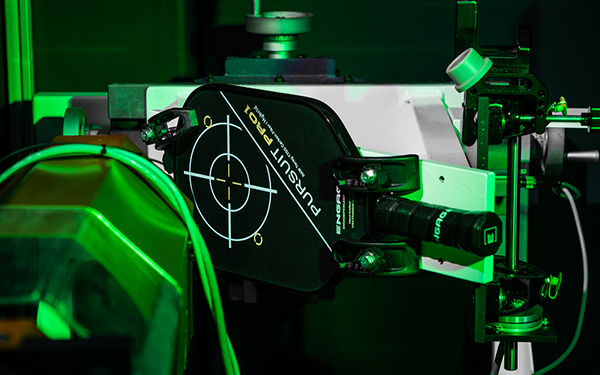
Spin Rate Testing
We use high-speed cameras to measure a paddle’s ability to generate spin. We launch a pickleball at the paddle, mounted at a 45-degree angle, and then analyze the rebound angle to calculate the RPM measurements. Our tests evaluate both sides of the paddle multiple times to ensure accuracy.
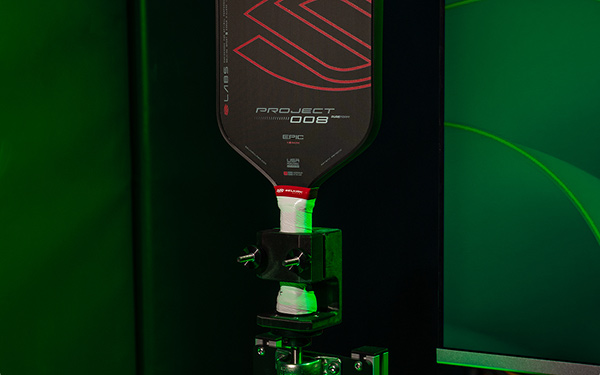
Twist Weight Testing
We use a spring-loaded oscillating fixture to measure the frequency at which the paddle oscillates when twisted. This measurement indicates how stable the paddle remains during off-center impacts, with higher twist weight values reflecting better resistance to twisting and, therefore, more forgiveness for less-than-perfect ball hits.
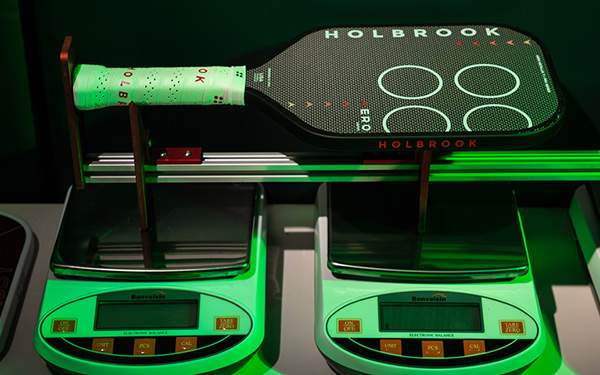
Balance Point Testing
We measure the static weight of the paddle at 2 inches and 10 inches to determine how the weight is distributed along the paddle. This reveals the precise location where the paddle will balance on a pivot, assisting players in understanding whether the paddle is head-heavy, handle-heavy, or evenly balanced for optimal control and power.
Exit Velocity Testing
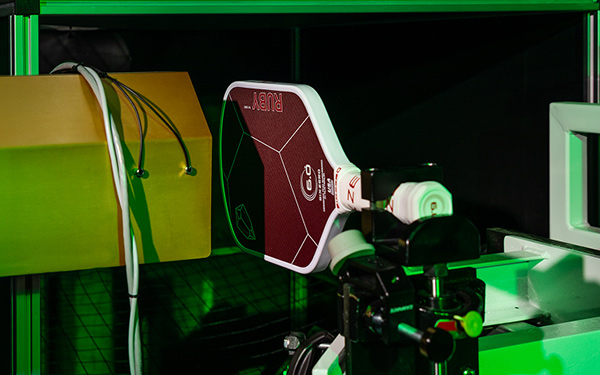
We fire a pickleball from a cannon at 60 mph (which simulates a 40 mph inbound speed combined with a 25 mph swing speed) at multiple points along the paddle face. Our equipment measures the ball's exit speed at each point, and we calculate the paddle's power rating by averaging the top 25% of these measurements, providing players with an accurate representation of the paddle's true power potential.
Swing Weight Testing
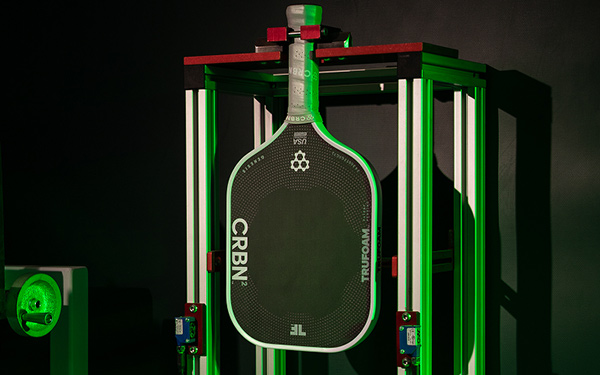
We measure swing weight using a pendulum fixture that follows the ASTM F2398 standard to calculate the period of the pendulum and weight properties. This indicates to players how heavy the paddle feels during actual play, with higher values signifying a paddle that requires more effort to swing but may deliver more power.
Consistency Testing
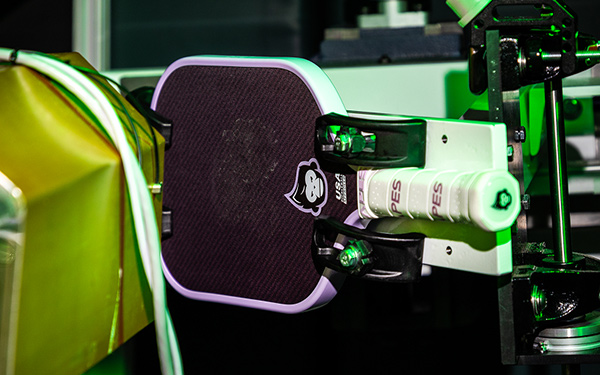
We analyze the variation in exit velocity across multiple points on the paddle face to evaluate paddle performance. Next, we create a performance curve and calculate the standard deviation of these measurements. A lower standard deviation indicates a flatter curve and more consistent performance, whereas a higher standard deviation shows more variability in performance across the paddle face.
Top Perfoming Paddle Guides
Browse the JustPaddles Paddle Lab Guides
FAQ
Each paddle undergoes rigorous testing in controlled conditions. We utilize specialized equipment, including high-speed cameras, ball cannons calibrated to 60mph (simulating real game speeds), and precision measuring tools. Every metric is tested multiple times to ensure accuracy and consistency.
No. We purchase all paddles directly from vendors to maintain our complete independence. This ensures that our testing remains unbiased and objective, providing you with results you can trust.
Our lab employs professional-grade testing equipment, including high-speed cameras to measure spin rates, precision impact testing machinery, and specialized tools for assessing weight distribution and balance points. Additionally, we conduct all our testing using the Franklin X-40 ball.
While our primary focus is on performance metrics, we also note any durability concerns observed during testing. However, long-term durability testing would require extensive play testing beyond our current scope.
Yes. While our scores accurately reflect measured performance, we can’t measure personal preference. For example, two paddles scoring 80 in power might achieve that through different combinations of characteristics. Therefore, we encourage using our data as a starting point to help you decide on the right paddle for your game.
Want some help?
Hey, we get it — data can be a lot to take in! If something doesn’t add up or you’re scratching your head, don’t worry, we’re here to help! Shoot us an email at support@justpaddles.com and let us know what’s confusing. We’re always improving and would love your input to make this even better. Let’s build the perfect paddle comparison system together!