
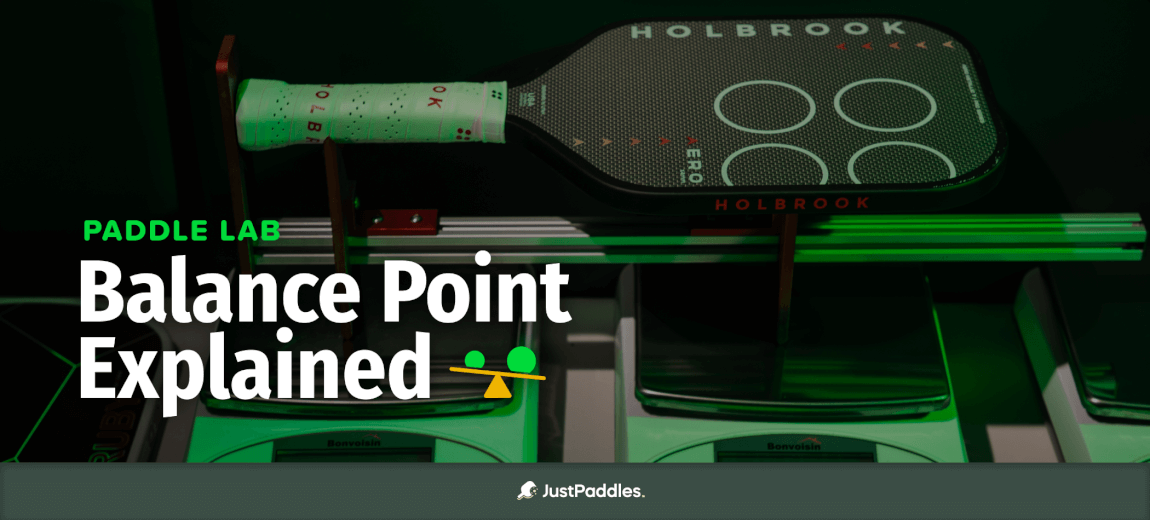
Have you ever picked up two paddles that weigh exactly the same but feel completely different in your hand? One might feel heavy and powerful, while the other feels quick and maneuverable. The difference you’re feeling is likely its balance point.
Balance point is one of the most overlooked specifications in paddle selection, yet it has a big impact on how a paddle performs in your hands. This is exactly why the Paddle Experts at JustPaddles measure balance points in our Paddle Lab testing, giving you the objective data you need to find a paddle that truly matches your playing style.

What is Balance Point?
The balance point is the distance from the handle base to the point where the paddle balances perfectly.
When you place a paddle on a fulcrum, the balance point tells you exactly where that fulcrum needs to be positioned for the paddle to remain level. This measurement reveals how the paddle's weight is distributed along its length.
Higher balance point = head-heavy paddle = more power
Lower balance point = handle-heavy paddle = greater maneuverability
Think of it like a seesaw. When more weight sits toward the head of the paddle, you get a head-heavy balance that generates momentum and power. When weight is concentrated toward the handle, you get a handle-heavy balance that promotes quick hands and better control.
Why We Test Balance Point
Balance point is often overlooked compared to specifications like paddle weight or face material, but it has a serious impact on playability. Two paddles with identical static weight can feel completely different depending on their balance point.
Without balance point data, players often struggle to understand why paddles feel different or which paddle might work better for their playing style. Subjective descriptions like "feels powerful" or "good for control" don't always give you enough information to make informed decisions.
Our Paddle Lab testing takes the guesswork out of this equation. We measure the balance point for every paddle, so you can see whether it leans toward power or control before you buy. Instead of wondering how a paddle will feel in your hands, you get concrete data that shows exactly how it's designed to perform.
How We Test Balance Point
Our Paddle Lab uses a straightforward approach to measure balance point consistently across all paddles.
The Testing Process
We measure how much the paddle weighs at 2 inches and 10 inches along its length. This tells us how the weight is distributed and where the paddle would naturally balance if you placed it on a pivot point.
From there, we can tell you whether a paddle is head-heavy, handle-heavy, or evenly balanced. You get a clear answer that lets you compare paddles meaningfully, rather than relying on vague descriptions.
Since we test every paddle the same way, you can trust the data when you're comparing options from different brands or construction styles.
Understanding Balance Point for Your Game
Balance point preferences usually line up with how you like to play, but the right choice depends on what matters most in your game.
Head-Heavy Balance (Higher Balance Point)
These paddles add momentum to your swing, which is great if you want power, stability, and that "plow-through" feeling on drives and overheads. The extra weight toward the head helps you generate pace without working as hard.
Head-heavy paddles work well when you:
- Love aggressive baseline play
- Want extra power on serves and drives
- Prefer to end points with pace rather than placement
- Have strong wrists and can handle the extra momentum
Handle-Heavy Balance (Lower Balance Point)
These paddles support quick hands, control, and finesse shots. With more weight toward the handle, the paddle head feels lighter and more responsive. Perfect for fast reactions and precise placement.
Handle-heavy paddles are the best option when you:
- Focus on soft game and kitchen line play
- Value quick hands over raw power
- Live for dinks, resets, and touch shots
- Want maximum maneuverability for defensive play
Even Balance
These paddles give you a bit of both worlds, making them solid choices for all-court players who want decent performance across different shot types. You get reasonable power without giving up too much maneuverability.
Looking for that happy medium? Here is one of the more balanced paddles.
Finding Your Sweet Spot
Balance point isn't about finding the "perfect" measurement, it's about finding what works for you. Think about how you currently play, where you want to improve, and how you prefer to win points.
Your physical strength matters too. If you have less wrist and forearm strength, handle-heavy paddles might feel easier to control. If you've got strong wrists, you can probably handle head-heavy options for that extra power boost.
The goal is matching the paddle's balance to how you play and what feels comfortable.
Better Decisions Through Real Data
When understanding balance point, it’s important to think about how a paddle actually feels when you're playing. We test and publish these measurements so you can choose paddles that truly match your style, whether you want more power, more control, or something in between.
Thanks to Paddle Lab, this real data takes the guesswork out of paddle shopping. So instead of hoping a paddle will work for you, you can make decisions based on how it's actually built to perform.
-
Ready to find your ideal balance point? Shop JustPaddles and browse through Paddle Lab data to see balance point measurements for hundreds of paddles.
Want recommendations based on your specific playing style? Take our Paddle Coach quiz and get paddle suggestions tailored to how you actually play.
 TRY OUR PADDLE COACH
Answer a few simple questions to find your perfect paddle.
TRY OUR PADDLE COACH
Answer a few simple questions to find your perfect paddle.
Need help making sense of the numbers? Chat with one of our Paddle Experts who can explain which balance point measurements work best for your style of play.